1940 - 1944: The school in Carmarthen
The Carmarthen years: 1940–1944
As you have hopefully already read (if not click here), the school was rapidly evacuated to South Wales, within three weeks of the German invasion of Belgium at exactly the same time as the Dunkirk evacuation was coming to its end. Ephraim Oakes, the school’s Headmaster, was faced with two great challenges: firstly, to find school buildings big and well-equipped enough to house his 200 students; secondly, to fulfil his promise to parents and a ‘hostel’ that could house them all together.
Sharing Queen Elizabeth Boys' Grammar School in Carmarthen
Just after their arrival in Wales, Ephraim Oakes had been given the opportunity to share the school facilities of Queen Elizabeth Boys' Grammar School in Carmarthen. There are few pictures of that school building available as the buildings have been pull down and replaced, but the image below is from the school’s alumni Facebook page and gives an indication of its likely size and style.
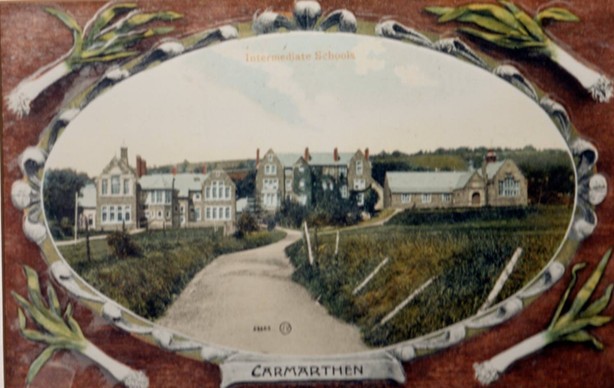
It turns out that the Queen Elizabeth Boys’ Grammar School had not been consulted about sharing its facilities, so the situation must have caused some friction. Historical research undertaken at the University of Wales (click on the link to read more) showed that 'the Clerk to the Governors of Queen Elizabeth Boys' Grammar wrote to the Carmarthen Education Authority protesting about the fact that the Sir Roger Manwood’s School was evacuated to the school without any consultation. The Governors instructed the Clerk to enquire into the financial aspects of Sir Roger Manwood’s occupation of the school especially in regard to the wear and tear on laboratories and other specialist equipment.'
And it seems that this situation was less than ideal for the Manwood’s staff. Shirley French, daughter of Ephraim Oakes, wrote many years later, 'The outbreak of war saw 8-year-old me sent to join my Godmother, headmistress of a girls' boarding school in Worcester for safety, whilst my family and the whole school were sent to Penclawdd in South Wales till a couple of weeks later they all moved to Carmarthen. I joined them in holiday times. I remember it being very stressful for all the staff, sharing Carmarthen Grammar School facilities, 1/2 day for each school and then, I guess, Field Studies!'
D. H. Romney (1940–1947) shared his memories of the chaotic nature of the combined school: 'When I joined the School in Wales in 1940 everything was so new as to be confusing. The masters and older boys appeared infinitely aloof. The mere problem of living seemed too complicated to be borne. Strange classrooms converted from kitchens. Every rugby practice on a different borrowed pitch and incessant minor worries of lost gym shoes, new rules, communal restaurants and such-like. On reflecting, I wonder how Mr Oakes and his dwindling staff ever coped with the never-ending problems. It is amazing how little studying we really did, and how promptly we stopped studying when our teachers relaxed their attentions. The only masters for whom I really worked were those that I feared, and I am indebted to them, for they alone are responsible for any success that I have had. Thus my memories of Wales are of extra classroom events. I remember innumerable cross-country runs and walks: indeed, for four years I walked two miles to-and-from school every morning and every afternoon. I remember those glorious scrums every morning, when 800 boys attempted to buy 800 Chelsea buns in 15 minutes from one small van, the doors of which were broken off approximately monthly. I remember with respect the occasion when Fifth Form justice was meted out by means of cricket bats and corps belts to a form suspected of letting down the school by stealing gym shoes from our hosts. Let us not forget, however, the kindness of all those people who shared their rations and their homes with us. And we seniors when we left Wales had broadened our outlooks. We had seen a different people in a different country; a Welsh school where the emphasis was on training to live in a multi-stratum society rather than to groom children to live among the fortunate few, as so many English schools seem to do.'
Pibwrlwyd, the ‘hostel’
Ephraim Oakes had not only obtained a school, but he also got his hostel, just as he had promised the parents, less than a month earlier in Sandwich. The building was the Carmarthenshire County Council Farm Institute, at a place with the strange sounding name of Pibwrlwyd (Pib-oor-loo-id). Around 50 Manwoodians were based at ‘Pib’, as it was fondly called, from June 1940 to July 1943, along with the headmaster and his family and Mr Lawrence. The remainder of the boys were billeted in private houses in Carmarthen.
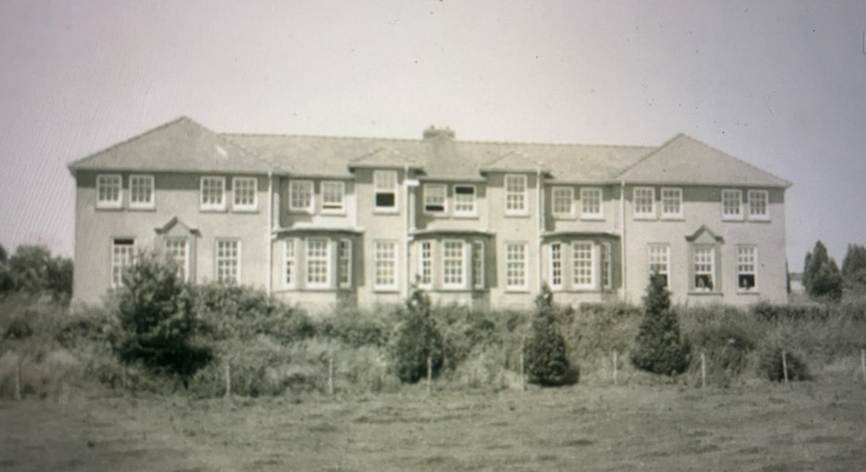
The Manwoodian notes 'The Institute had closed down, seemingly for the duration of the war, a few days after our evacuation and we were lucky to get hold of it. The Hostel is in a glorious stretch of country and the buildings comprise a Dining Hall, good kitchens, lavatories, baths, etc., a laundry, 3 good rooms for use as Common Rooms, Reading Rooms, etc., 24 cubicles, bed-sitting rooms for the staff, and 2 large rooms which had been used as butter and cheese dairies, which have made good dormitories; all heated by central heating and with electric light. We managed to get the furniture and equipment moved from the School House at Sandwich to Pibwrlwyd and on the 14th June, the great experiment began. Mr. Lawrence, (aka 'Hoff' the Senior Modern Language Master), took over the Housemastership of the Hostel. Three other Masters lived in and Mrs Blackburn joined us as Matron.'
There is no doubt that at first Pibwlwyd was regarded suspiciously by the boys. They thought of the 'freedom' of billets — going off to the cinema when they liked, staying up late at night — and contrasted this state of bliss with life at the Hostel, where there would be masters and prefects, rules to obey, fixed times to do this or that and cinema visits made to depend on all their work having been finished. Time removed that suspicion for most boys and a number moved to ‘Pib’ during August, while their billeters were away on holiday, and successfully persuaded their parents to let them stay when term started again.
The area around ‘Pib’
The boys took no time in exploring their new surroundings. They soon found that the town had historical associations. Ancient coracles, built almost exactly like those of the Ancient Britons, are still used by some of the inhabitants for fishing. The town has also legendary associations with King Arthur and the Knights of the Round Table. In Priory street is Merlin's Oak, upon which is inscribed the legend: 'When Priory's Oak shall tumble, Then will fall Carmarthen Town.' (The oak had already been poisoned by the time the Manwoodians arrived and was completely removed in 1978!)
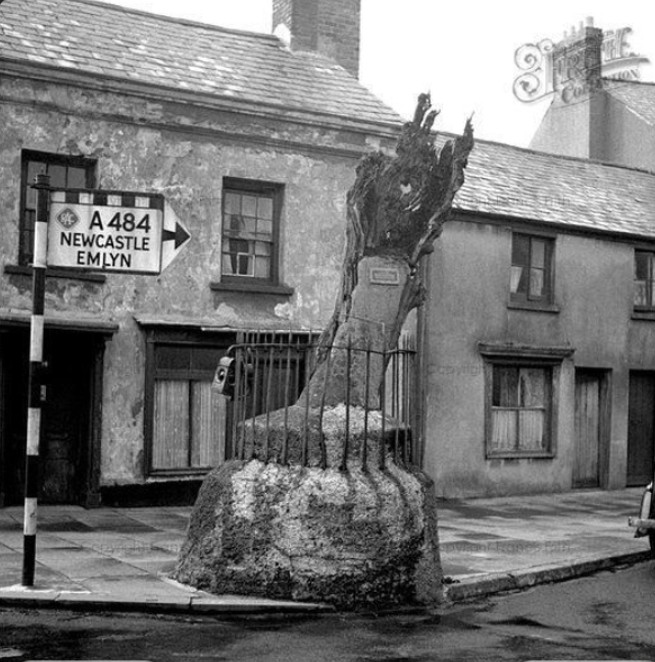
The Manwoodian goes on to say 'One of the favourite relaxations of Manwoodians, besides tennis and cricket, is cycling. Several expeditions have been made into the country and some intrepid cyclists have pedalled their way to Penclawdd to visit their former hostesses. Cycle rides are arranged on Games Halves, and one member of the staff has conceived the idea of charging 6d. for mending punctures. The farmers here are less obstinate than those of East Kent, and one can go for very enjoyable walks in the hills, over the rough pastures and through the hedges. Life is, however, not all pleasure here. Work is going on fairly normally, for examinations have still to be faced. Although it would not be in the interests of national security to state exact numbers, members of the O.T.C. have joined the Home Guard! Evacuation naturally incurs difficulties, yet everyone is glad that it is Carmarthen which has become the home of Manwood's for the duration of the War. Nothing can, of course, beat Sandwich, but we are, indeed, very fortunate in coming to this corner of Wales, among such kindly people.'
Life at ‘Pib’ for the boys
Again, The Manwoodian helps us understand the daily routine 'The boys who lived at "Pib" go to the Grammar School in Carmarthen for their lessons just as the billeted boys do, but at night they do their prep under supervision at the Hostel. There are plenty of recreations – ping pong, darts, cards, games of various sorts, sing-songs, play readings, charades etc. – and the County Librarian has kindly agreed to furnish a Branch Library at the Hostel, the books of which are changed regularly. The boys have readily agreed to do much for themselves; making beds, cleaning shoes, laying tables, washing up, and now we have obtained plots of land for them to grow vegetables for Hostel use. They have seized on the “Dig for Victory” slogan with enthusiasm! Those of us who see the daily life at Pibwrlwyd know that it is a success. The boys there, though longing to be back in Sandwich, would agree that it is proving a good evacuation haven for them.'
Dances with local girls were clearly an excitement for some of the older boys: 'In the estimation of the Upper School the focal point of the holidays was the long-promised dance. During the first weeks of the holidays, many evenings were given up to dancing. An amateur band from the Carmarthen School provided the music, making the affair a complete youth movement. After the initial introductions, the dance went with a swing, and was a complete success, and the bashful Vth soon ceased to blush. In fact, our fair partners proved the exception to the once-trodden-twice-shy rule, and returned later in the holidays for another dance. More time was spent out of doors during the Easter holidays, and there were few organised indoor entertainments. A dance took place with the now customary success.'
The O.T.C. (today's CCF) figures largely in the 1940–1945 pages, and unsurprisingly so ... 'The Contingent kept its chin well up throughout our exile. Mr. Cleverly answered the call nobly, and took over the command again in 1940 after Capt. Berry was called up: he and Mr. Schilling have instilled into the cadets a pride in their contingent which has withstood all assaults on morale: the band kept itself alive by enthusiasm and hard work. A new activity began to be recorded in the School's history during evacuation. We formed our own Scout Troop. The names of Mr. D. I. B. Jones (the District Commissioner for Carmarthen) and Mr D. O. Griffiths (our Scout Master) will always be associated with the birth of the Scout Movement in Manwood's.
Of course, getting any child to bed can be a struggle, particularly when there is a black out to be obeyed! 'The "black-out" has caused unceasing trouble: after no less than 5 “last" warnings the trouble has finally been remedied. Many amusing incidents occur during the dark hours. A boy may be walking peacefully along the corridor when he is suddenly attacked. A fierce struggle ensues, during which others join in. The instigator of all the trouble has sometimes been found to be none other than “Hoff”, who protests that in reality, it was he who was attacked!. Sometimes there arises a roar, as if there is an air-raid or earthquake. On investigating, however, the curious one finds that it is only Young telling some shivering little fellow that he ought to be in bed. At other times, one hears a gurgling, and spluttering sound, mixed with cursings, which give the impression that some poor soul is being strangled. Having approached gingerly, the bewildered person finds that it is only several boys doing their nightly "gargle," and putting in remarks on the taste of the stuff, between whiles. Well, such is life at Pibwrlwyd.
And what about the school holidays?
Of course, evacuees could not return home in the holidays. An account by AAH in The Manwoodian paints a rosy view of life at ‘Pib’ during those weeks off from study. 'I came to live at Pibwrlwyd during the holidays, and I have never been sorry that I did so. The communal life here provides much fun. We get better acquainted and become more willing to help one another. Life here is seldom dull. Every day brings innumerable humorous incidents to brighten our “exile.” In our housemaster, we have a participator in, and indeed, the leader of, the fun. He turns his grouses (which are few) into jokes, and if he is called up in the night to attend to some poor unfortunate nightmare victim he can hardly contain himself with laughter from the time he arrives on the scene till he returns to bed (and perhaps he still laughs in his sleep; who knows?).
Who were the staff who ran Manwood’s during its exile?
The indefatigable Ephraim Oakes was clearly a man of great energy and high standards, but he clearly had a great sense of humour, including playing the role of Father Christmas on Christmas Day. His role in keeping the school going during these war years was crucial, as former student D.R. Farrant wrote 'Yet the School was fortunately equipped for the event, for it possessed as Headmaster a man who, though established at the School for five years, was still young enough to adapt himself and the School to the new situations as they arose. Much of the credit for the School's survival in those days must go to E. P. Oakes, whose unflagging keenness and sheer determination helped to carry Manwood's through those war-time years. Most of us in the School tended to take evacuation rather as a matter of course. Few, if any, of us realised the immense administrative difficulties under which the Headmaster and his Staff worked at that time.' This included the gradual erosion of staff numbers, in part as they were called up for military duty.
George Rock was one of those carrying out that administrative work. He arrived at Manwood’s in 1915, became and was Senior Mathematics master and performed a lot of the school’s administration, including in the evacuation to Carmarthen. From 1939–1946, he kept the OMA together taking on the role of Hon Secretary. He ran the OMA single handedly, writing endless correspondence to OMs serving all over the world and organised food parcels to POWs. In his 'spare' time he served with the Royal Observer Corps.
We have already heard that Mr Lawrence (aka 'Hoff') was housemaster at 'Pib.” He clearly achieved great loyalty from his ‘boys’ with one Manwoodian account of life at ‘Pib’ being signed off as 'So now from Pibwrlwyd, “Au Revoir” and “Vive Hoff!"'
Others get a mention including the Cook 'Bones,' whose skills were praised in those accounts of Christmas and Mrs Blackburn the ‘kindly’ Matron: 'I was met by Matron who handed me a plate of eggs – things I had thought of only, for three months. This proved to be the forerunner of many good dishes to come.'
And what of the parents back in Sandwich?
Ephraim Oakes had met with the parents in the days before the evacuation and they must have been understandably concerned about how their children were faring as well as the costs of supporting. Snippets from The Manwoodian paint a picture of life from a parents’ perspective.
As Oakes wrote in The Manwoodian, 'We are having to pay a rather heavy rent for the Hostel which works out at approximately 5/- a week per boy (he had in fact told the parents to be prepared for 7/ a week). We are well aware of the financial difficulties which have confronted people whose livelihoods depended on the prosperity of East Kent, and we want to do our bit by avoiding unnecessary financial demands on their diminished resources.'
The Manwoodian notes that 'Quite a number of parents have been to Pibwrlwyd to spend a holiday: if accommodation permits we always welcome such visits as they enable parents to see how their boys are living. They have proved a great success and rooms have been booked for repeat visits.' Parents even came for Christmas as this account from The Manwoodian, entitled "Pibwrlwyd Makes Whoopee!" (by S.G.Y), makes clear: 'Tradition has it that a holiday at school is akin to penal servitude, full of boredom and unhappiness, but no one seemed downhearted at staying at Pibwrlwyd for Christmas. The house was agog for the last week of term with propaganda (officially sponsored?) about the fine times ahead. The first material sign of festivity was the appearance of decorations, including a Christmas tree, given by a "Mr. Smith.” We feel that "Mr. Williams" would have been a happier choice in Wales. The festivities began in earnest on Christmas Day, and their chief form may be determined from the one fact that Cook's name was praised to indeterminate heights. All kinds of peacetime delicacies appeared as if by magic. The traditional oligarchy was abandoned, and democracy took its place; masters, first formers and prefects sitting jumbled together. After these excesses the authorities deemed a six mile cross country run necessary. A series of party nights followed, in which parents and staff joined with the boys in playing the usual party games – the more childish the game, the more did the parents excel.'
One Manwoodian article offered "A Parents' impression of Christmas at Pibwrlwyd": 'Although not fortunate enough to be at Pibwrlwyd for Christmas Day, I was in time on Boxing Night to appreciate the goodwill and atmosphere of Christmas. Then for a week of fun, games, entertainment, treasure hunts, and plays from all departments – special item a dance in which the boys, although they had only newly acquired the art, danced with grace and enjoyment, following which was a marvellous supper which was no less popular! Next day a party for the little boys, and New Year's Eve another festivity with dancing, etc., the Prefects welcoming 1941, finishing with the singing of “Auld Lang Syne”. The billeted boys were not forgotten. They too came in batches to the Hostel to enjoy and share this festive spirit. Throughout all this, the Headmaster and Mrs. Oakes spent their time in giving pleasure and enjoyment to everyone present. Congratulations to all who have helped to make this first Christmas away from their homes perhaps the happiest the boys have ever spent.’
The end of ‘Pib’ in September 1943 – everyone off to billets!
Ephraim Oakes had already dealt with a large number of challenges when the local authority announced the reopening of the Agricultural College that had formerly been housed at ‘Pib’. D.R. Farrant writes 'In 1943 it was returned to its former use, after prolonged public debate involving Mr Oakes and the local authorities – debate which was at times acrimonious.' Now everyone had to be billeted in the town, so 'when it became apparent that Pibwrlwyd could not be retained, the Headmaster threw life and soul into the problems of finding billets for the Pibwrlwyd boys. In this, his work was not easy, for there were both bad billets and unbilletable boys. Faced with a local population which was not always aware of the hardships of war, Mr Oakes did not hesitate to speak his mind. Many Carmarthen people disliked what he said: many others admired his courage in saying it.'
It was clear that the loss of ‘Pib’ meant a loss of a central core to school life. The Manwoodian went on to say that 'Pib was not merely a help in the billeting problem, it was a grand success in its own right, and many boys (some now in scattered parts of the world) look back with pleasure and gratitude to the warm, communal life which was theirs, they think of "Hoff" (alias Mr. H.T. Lawrence, M.A., Housemaster!), Cook "Bones," of the kindly ministrations of Matron, Mrs Jolley and Mrs Oakes, of grand times at Christmas, of rain and floods, missing or (occasionally) catching the bus, long hikes, and longer cycle rides, blackberrying, camping, potato picking, debates and mock trials — it was a black day for our evacuated school when we were compelled to give up the buildings in August 1943, and rely entirely on private billets.'
As an example of one of the more glamorous billeting locations, Alan Radcliffe (1941–1944) remembers Life at the Bishop's Palace at Abergwili in 1943/44. 'The Bishop of St. David's, David Prosser, agreed to take six boys at his palace in Abergwili.' (see picture below)
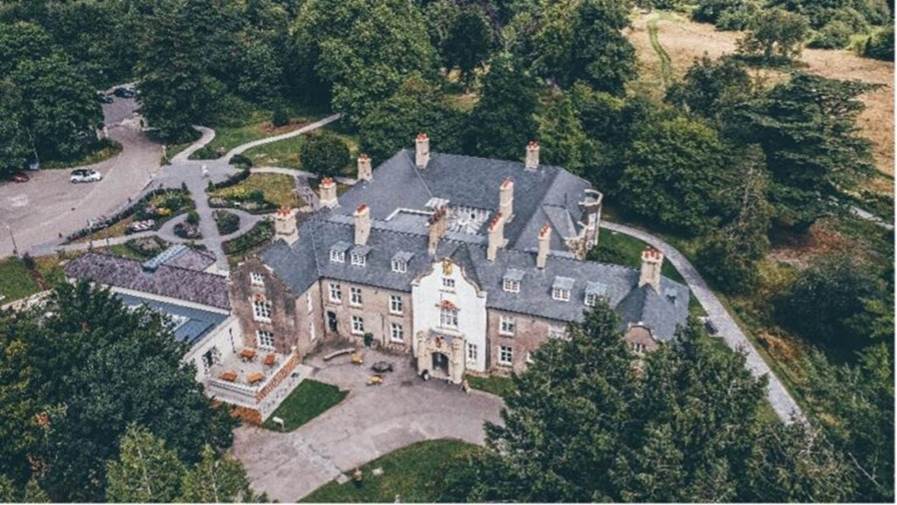
'I was one of the six. We were most impressed with the Palace on arrival one evening in September 1943. We shared 3 bedrooms on the first floor, 2 boys in each, ate in the kitchen, which had a large table, and had a separate room in which to do our schoolwork. We were allowed to explore a large area of the Palace as well as having the run of the grounds. The food was quite good in spite of wartime rationing. Our weekly sugar ration was put into jam jars with our name on it. Once it was gone, it was gone and one might have to wait 2 or even 3 days before it was filled up again. We travelled to Carmarthen to go to school by bus, bike or even by foot. The American soldiers arrived in late 1943 and soon all the local roads were a sea of mud as they set up camps in the fields between Abergwili and Carmarthen. They did provide chewing gum and candy from time to time but soon got fed up with all the kids pestering them. We were expected to attend a morning service in the Bishop's private chapel every morning at 07.30. This lasted about 20 minutes. The Bishop liked one of the boys to serve dinner to him as it gave him an opportunity to talk to us. It was rather nerve wracking for a 11 year old but one of the maids came with us the first time and showed us what we had to do.’
Billeted life for the boys continued until the end of 1944, when the school made the decision to return to Sandwich which will be the subject of a separate article.
Sources and credits: Much of his article was written by Keith Simpson (OMA) in 2024, drawing on research, primarily from editions of The Manwoodian, with additional research by David Anderson (School Development Officer in 2026)