1940: Manwood's evacuation to Wales
The editor of The Manwoodian in 1945 mused, 'I have just been turning over the pages of all The Manwoodians published since 1940, and I realise that I have been turning over momentous pages in the book of the life of the school.' Keith Simpson of the OMA, who researched this article and turned over the very same pages 80 years later, echoed the editor’s sentiments – this was indeed a period in which the school may only have survived as a viable entity due to the astute leadership of the Headmaster, Ephraim Oakes, and his staff who held together the boys and maintained an esprit de corps over four and a half years.
Evacuation plans in the lead-up to the outbreak of war
In the run-up to the Second World War, the government feared high civilian casualties as a result of German air raids. The invention of the long-range bomber meant that the general fear of war intensified in the 1930s. The government estimated that up to 600,000 civilians might be killed in the first few months of any conflict. To avoid the chaos of a mass migration of people from urban centres in the event of war, the government drew up plans for an official evacuation of children to parts of Britain unlikely to be targeted by German long-range bombers. Most of Wales, including the industrial valleys, was designated a 'reception area' (you can read more about those plans here).
Two days before the British declaration of war on Germany (3rd September 1939), a mass evacuation scheme began in a huge logistical exercise involving thousands of volunteers: Operation Pied Piper. It saw a first wave of 1.5 million children, pregnant women, mothers with infants, and the frail and disabled evacuated from urban target areas to safety in the countryside. It may seem strange that the area of East Kent, which was to become known as Hellfire Corner, was at first considered a safe haven for evacuated children from South London (read more by clicking on this link) given concerns about bombing. But children from Gillingham were brought down to Sandwich where Sir Roger Manwood's School could shelter them. However, the Government demanded that for every 100 hundred people housed in the same place, an air raid shelter must be provided. This was not possible at first and so students were dispersed around the town for safety.
The Fall of France and a week's notice to evacuate
In the first few months after the outbreak of war, the expected German bombing raids had not happened (the ‘Phoney War’). There was a false sense of security and by January 1940, almost half of the evacuees were brought home by their parents. But that ‘Phoney War’ did come to an end with the Fall of France in the summer of 1940, leading to the carrying out, at short notice, of the plan to use Wales as a ‘reception area’ for evacuees.
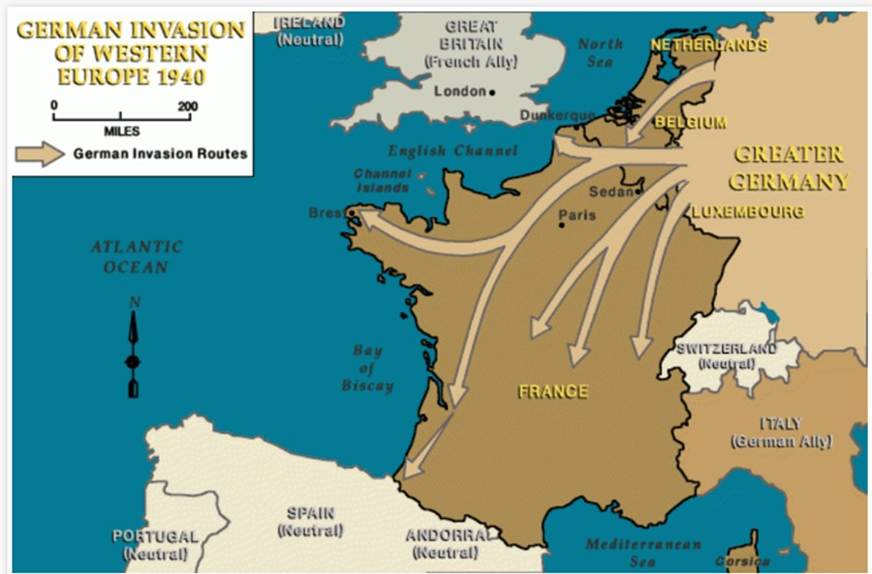
The speed of the Fall of France and the timing of the evacuation of Manwood’s on June 2nd demand some scrutiny if we are to understand the immense challenge placed on all involved in planning a successful evacuation – whether government officials, governors, teaching staff or parents. Within just 3 weeks of German forces entering Belgium, Manwood’s was on the eve of its evacuation. Less than 2 weeks later, Paris had fallen.
10th May | German forces move into Belgium, Luxembourg and the Netherlands |
17th & 18th May | Antwerp and Brussels fall |
20th May | German forces reach The Channel |
26th May | Operation Dynamo, the plan to remove soldiers from the beaches of Dunkirk, using small boats, was ordered to commence |
27th May | The German Luftwaffe destroyed Dunkirk harbour. 7,669 troops were rescued on the first day of Operation Dynamo |
28th May | The Belgian Army surrendered. 17,804 troops rescued from Dunkirk |
29th May | A maximum effort was launched by the Luftwaffe. The French army joins the evacuation effort, and 47,310 troops were rescued. |
30th May | Bad weather interfered with the Luftwaffe, and German Panzers withdrew from Dunkirk with 53,823 troops being rescued. |
31st May | 35,000 troops were captured at Lille. Operation Dynamo sees its biggest day, with 68,014 troops being rescued. |
1st June | Clear weather gives the Luftwaffe its biggest day, sinking four destroyers and 27 other vessels. That day 62,429 troops were rescued. |
2nd June | BEF evacuation was completed with 26,256 troops rescued. Manwood’s is evacuated. |
4th June | The last night of Operation Dynamo; 26,175 troops were rescued. |
14th June | Paris falls |
Parents’ concerns and the Headmaster's challenge of finding a new home
With such short notice of evacuation, parents were understandably concerned by the conditions that their children would experience in Wales. Imagine being in the shoes of Ephraim Oakes as he faced parents in the School Hall, just a few days before the evacuation. As Oakes reported in 1940 'After some discussion the Headmaster gave a promise that he would try to find some building or buildings in the Reception Area which could be used as a school hostel, where boys could live instead of in billets. An undertaking was given that the hostel would be run as economically as possible and that it would be on a strictly non-profit basis. An estimate was given that parents of boys in the hostel would probably have to pay about 7/-per week directly to the hostel, in addition to any sum they contributed to the Government under the official Evacuation Scheme. The meeting was enthusiastically in favour of the school hostel plan and a large number entered their boys on a provisional list for admission to a hostel if it could be obtained.'
Evacuation Day – Sunday 2nd June
The Manwoodian of 1945 gave a sense of the arc of the story of the school’s evacuation:
'On the 2nd June, 1940, a brilliant summer's day, with the sun shining ironically from a cloudless sky, we left Sandwich bound for a place in Wales which nobody seemed to have heard of, not knowing what the future held for the beloved buildings and town we were leaving behind, or for the boys who were going out into a strange part of our islands. It was only on the 30th January, 1945, that the school re-assembled in its own home. Instead of the brilliant summer's sun which shone on our departure, a snow-covered landscape was the background for our reunion – but the cold could do little against the warm thankfulness in our hearts that we were home again.'
The Swansea History Journal adds some details 'After breakfast, the boarders were joined by the rest of the day boys and the whole school, nearly 200 strong, set out for Sandwich station where a special train was waiting. The school governors and many parents were on the platform to bid the boys and staff farewell. "There goes young England; we must be worthy of them" remarked the Chairman as the train departed for an unknown destination. Each pupil was allowed to take a small case containing sufficient clothes for two weeks, their gas mark and food and drink for the journey to their mystery destination. Their large trunk/case and bicycle would follow on in the railway goods van.'
Ron Southey, a day pupil at Manwood’s from 1932–1940 gave a detailed account of the journey to Wales with a boyish take (although he was in his last year at Manwood's at the time) on such a momentous day when children left their homes and families for an unknown period of time:
'One road leads to London, One road leads to Wales. On Sunday, June 2nd, Manwood's set out on this second road, yet, like Masefield, with little enthusiasm, for the circumstances necessitating the journey were tinged with sadness. The school assembled at a slightly earlier hour than usual, and although arrangements had of necessity been made in great haste, fine organisation by the staff ensured a perfect day. Setting out on this new adventure the school seemed in good spirits, although the boys had missed that extra hour in bed which Sunday allows to the tired scholar. In a short time everyone was seated in the train - and what is more – comfortably seated. Even before the train started, many had resorted to the favourite remedy for boredom – eating! Indeed this seemed the popular pastime throughout the day and undoubtedly the hand luggage of many boys must have consisted entirely of food. The journey was not lacking in interest, for it was the time of the return of the heroes of Dunkirk, who were often seen in trains along the line. In spite of their personal sufferings they seemed to sympathise with these unfortunate children taken from their loved ones. One of the high spots of the journey was the passage through the Severn tunnel, which was eagerly anticipated for many hours. Many were of the opinion that this heralded the end of the trip, but it was found that the most tedious part was yet to come. passing through the contrasting filth of industrial towns and the verdure of the Welsh hills, we arrived at Gowerton station at 6.15(pm). Buses quickly conveyed the boys to Penclawdd (pronounced Penclouthe) where tea and sandwiches were provided by kind helpers. After a brief medical examination, the arduous task of billeting (putting students with local families) was tackled.' The youngest boys were billeted first, with all teachers and staff being found accommodation by midnight - clearly no easy task.
A different perspective of the journey was given in Country Boys: recollections of a lifelong friendship, by Roy Williams, given at the funeral of John Casper in 2006.
'We both went to Sir Roger Manwood’s School shortly before war broke out. On 2nd June, 1940, we were among the hundreds of boys packed tightly on the train at Sandwich station, evacuated as Britain was left to stand alone against Hitler. We had never ventured far from the fields and woods and streams around Eastry and Worth. Now we were on a train ride to an unknown destination. We set off at 8.30 in the morning and travelled all day, trying to work out where we were. I remember stopping to let troop trains go by. We didn’t realise it then, but these were the troops who had got away at Dunkirk. Somebody said we were going through the Severn Tunnel, so we were in Wales. And at 6 in the evening we arrived at a town we had never heard of, Gowerton. We all trudged a mile to the village where we were to be billeted, me with Shooty Hopper, John with Colin Carpenter, from the ironmonger’s in Sandwich. Our school was homeless for a while, but the weather was fine all through the summer of 1940, and we did our lessons out in the sun on the side of a hill.'
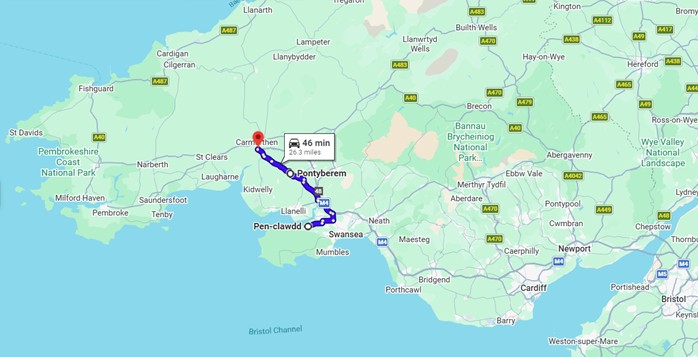
The map shows the location of Penclawdd on the picturesque Gower Peninsula, just to the west of industrial Swansea.
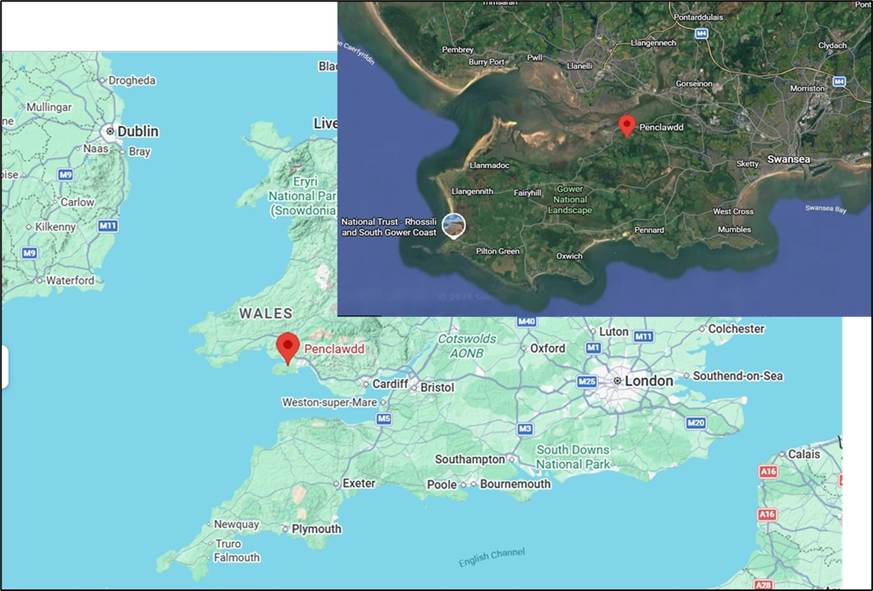
Life in Penclawdd
Penclawdd was a quiet village on the Gower Peninsula; quiet that is until Manwood's arrived. Within a few weeks, we boys enjoyed our lessons in the hedgerows and on the beaches (see further images of Penclawdd by clicking on this link – it's a very distinctive village). In many ways, this village that lined an estuary of mudflats and saltmarshes might have felt strangely familiar to those born within a few miles of the mouth of The Stour.
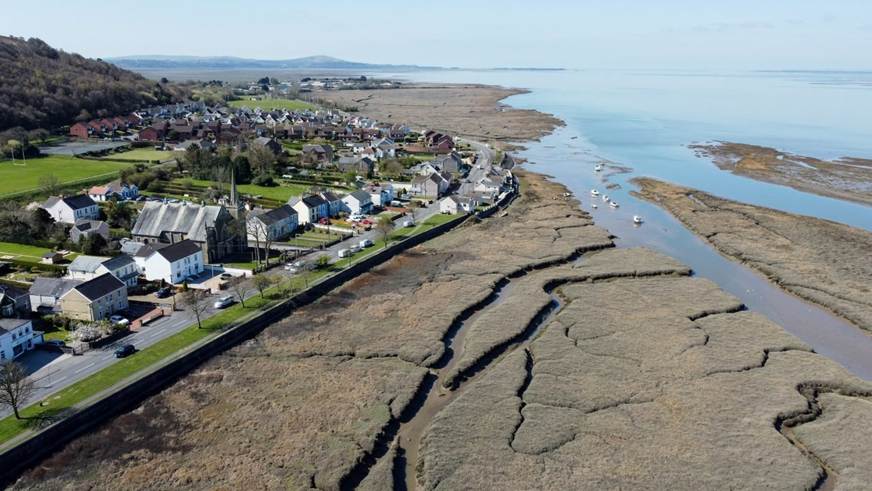
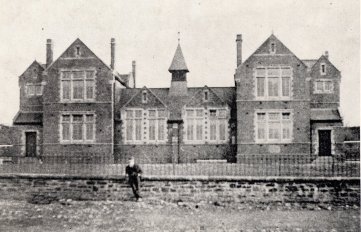
Whatever may have been the feeling on arriving, by the next day the boys felt perfectly at home. Penclawdd, this simple cockle village, showed Manwood's a spirit of hospitality that many had not seen before nor have witnessed since. Naturally there were difficulties such as the dilemma of the boy who found his would-be billeter had already departed this life. On the Monday, the whole school enjoyed a delightful bus trip around the Gower Peninsula, picnicking at Port Eynon. The excursion revealed for the first time to many a new type of scenery. To the disgust of some (but to the credit of the organising powers), work was begun on Tuesday, although on a limited scale. By the end of the week the senior forms were working to a fixed timetable in the Gowerton Grammar School (we assume that it was in the boys' school - the picture below - the Gowerton schools have a website - click here).
Neither was the sporting side of the school neglected; on the Thursday, the 1st XI gained a comfortable victory over the village team, although the game was played on a somewhat unusual pitch. During their brief stay, a few other matches took place, in which great keenness was visible on both sides. On the one Sunday they were in Penclawdd, part of the school attended the Church of England and the rest the Calvinistic Methodist Tabernacle. At the latter, the boys witnessed an almost unique type of service, in which both the Welsh and English languages are used. They also had a taste of the fiery Welsh preaching with its characteristic 'hwyl.' The Swansea History Journal adds 'Compulsory baths were taken at Penclawdd Rugby Club and there were occasional trips to Port Enyon bay for a swim. Jack Hoppe was very aware that he was being hosted by a community that lived and breathed rugby and how proud it was of the two Gowerton Grammar school boys, Haydn Turner and Willie Davis, who played in the Swansea team which defeated the New Zealand All Blacks in September 1935.'
Despite the idyllic surroundings in Penclawdd, the school’s sudden evacuation there had undoubtedly created challenges as this recollection in The Swansea History Journal, written by an evacuated Manwoodian who returned to live in Swansea, suggests.
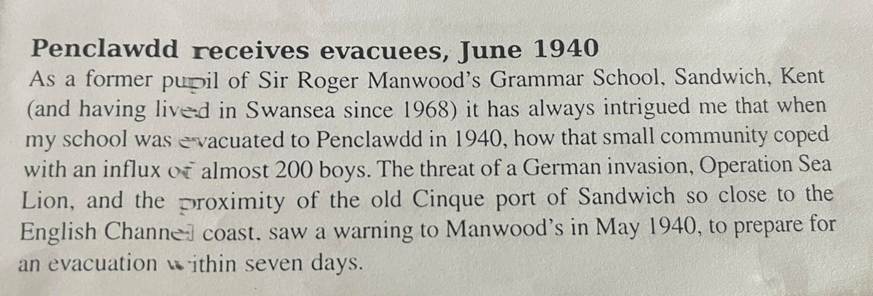
And Ephraim Oakes, the Headmaster, would have been acutely aware that he had not yet fulfilled his promise to parents to find a hostel for the students. Instead students were billeted with families across the areas around Penclawdd. In addition, he had not yet secured a school building that was big enough to accommodate 200 Manwoodians. Despite the warm welcome, there was clearly concern in the local community about how such a large influx of evacuees could be supported in a village that was too small and isolated to be considered a realistic permanent base for the school.
Leaving Penclawdd
So, less than two weeks after their arrival, the school left to find a semi-permanent home. The night before departure, the villagers organised a farewell concert in the Tabernacle Chapel, in honour of their guests. Mr Oakes gave a speech of thanks, with a few words in Welsh. Jack Hoppe remembered 'the absolute beauty of the singing and a young woman in a black dress singing "Just a song at Twilight."' Furley Spanton later reminisced 'that whilst our stay in Penclawdd was short, I can only say that the people of the village did all they could to help and comfort us. I have only ever known that in Welsh people.'
The following departure was described by a student of the time (B.G.B.) in The Manwoodian.
'Friday, 14th June, the village gave the school a grand send-off. We left Penclawdd on a fine sunny day, our departure being watched by nearly all our new friends. Everyone, both in the school and the village, was sorry we were going. Goodbye to the village, the sands, the donkeys and the cockles! After we had left Penclawdd we still bore with us our appreciation of the hospitality of the people. Those of us who are no longer in Wales will never forget the kindness of the Welsh. The journey to Carmarthen was uneventful except that some of the double deckers barely cleared the low bridges. We passed through hilly pastoral country, past a few collieries and factories, and through villages. At last we reached the top of a hill overlooking our new home.' (The map below shows the probable route and distances involved, although the time reflects today’s roads and vehicles).
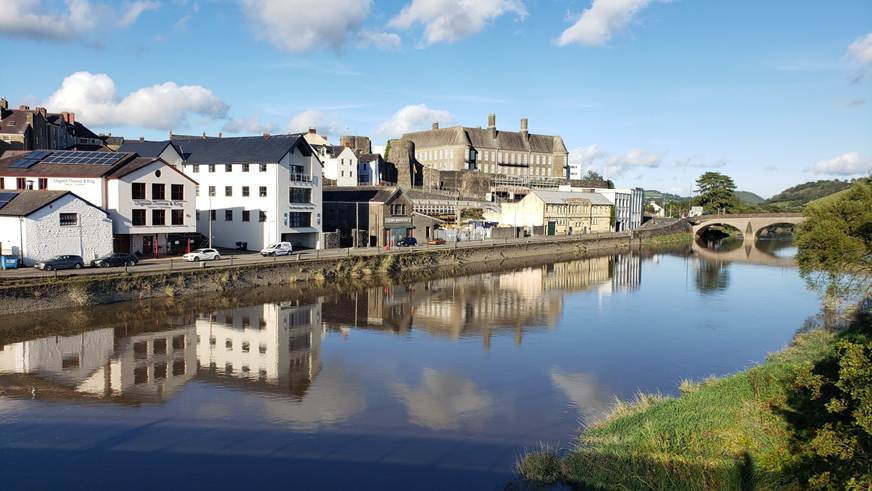
The view is best described in the words of a recent letter to the East Kent Mercury: 'From the top of a hill was the first view of this wonderfully clean picturesque town, looking as if it had been chiselled out of the rocky eminence on which much of it is built, with its famous river meandering along under a fine modern bridge.'
A separate article will cover the challenge that Ephraim Oakes had in fulfilling his promise to the parents to find accommodation large enough for his 200 students in Carmarthen.
Sources and credits: The research and much of this article was written by Keith Simpson (OMA) in 2024. Keith drew primarily on research from editions of The Manwoodian. That material has been expanded by David Anderson (School Development Officer) in 2026, using materials posted on the OM Facebook group, as well as articles found in further research, including those from The Swansea History Journal.