1563: Founding of the School
Most people with a connection to Sir Roger Manwood's School are familiar with the date of 1563. Some may have even spotted that the original school building on Strand Street bears the date 1564. But I'm sure that many of us have questions about the founding of the school that were never answered during our time at Manwood's. For instance, was it always called Sir Roger Manwood's School? Was Roger Manwood really powerful and rich enough to have founded the school on his own? Why did Sandwich need a grammar school when it was already turning out very influential people like Roger Manwood, who by that point was one of the most powerful judges in the land? And given the jumble of dates, when was the school actually founded and when did it start teaching children? Hopefully, these questions and others will be answered as you read about the founding of the school.
A dearth of education and a call to action
The town of Sandwich felt great hardship when the chantry school at St Peter’s was closed in 1547 as part of the Reformation (you can read more about the link between the Reformation and the closure of the chantry schools by clicking here). For 155 years it had provided generations of Sandwich boys, including Roger Manwood, with a free, simple but basic education. Holinshead (the English historian) records how the closing of the chantry affected Sandwich “The children of the townspeople, being many in number, were forced to be taught in the grammar schools far distant from Sandwich, to the great charge of their parents.”
In 1561, three years after coming to the throne, Queen Elizabeth asked her bishops to report what schools existed in their dioceses. In Kent the main ones were at Canterbury (the old Archbishop’s School and the recently refounded 'The King’s School') and grammar schools at Wye, Maidstone, Tonbridge and Tenterden. The bishops no doubt took the opportunity to point out that now so much of the church’s land had been confiscated in the Reformation, that the church no longer had the capacity to fund the schools that the country needed.
Pressure was also building in Parliament. One of Manwood’s friends and colleagues was Thomas Williams who was elected Speaker of the House of Comomons in 1563. At the opening of Parliament in January of that year, he spoke of ‘three notable monsters: Necessity, Ignorance and Error’. This led him to speak of the shortage of schools that ‘brings Ignorance, the second monster; the universities are decayed, the great market towns and others without school or preacher’. Listening to this would have been Sandwich’s two MPs: Roger Manwood and Richard Perrot. It is probably no coincidence that within a few weeks of Speaker William’s speech, Manwood was taking active steps in his local sphere of influence.
The response of the people of Sandwich
The people of the town were also showing initiative. On 21 May 1563, at a meeting of the corporation at Sandwich ‘it was moved by the mayor, what a goodly act and worth of memory it should be, to make and found a free school within the town’. The mayor, Henry Boetler – a relative of the Manwood’s – went on to propose that 'every inhabitant in the town should consider the matter and say what they were prepared to give towards it’.
There was a generous response from all sections of the town. The mayor and his colleagues gave a total of £203. 3s 4d while 181 of the inhabitants subscribed £83. 3s. 10d. One person subscribed ‘work with painting’ and another was willing to give ten tons of timber instead of cash, if it was preferred. Wardens were appointed to collect the money and John and Thomas Manwood (jurats of Sandwich and brothers of Roger) were involved in this.
The role of Roger Manwood in the founding of the school
It was unthinkable that such a venture in those days could have flourished without patronage and influence – and wealth. Roger Manwood (he would only become Sir Roger Manwood in 1578) already had an interest in education; at the time he had the leading role in the training of new lawyers at the Inner Temple in London. With his legal mind and excellent connections, he was the obvious person for the town to rely upon. His first step was the most vital step of all; securing its future financially, for he promised to endow the school with an income to provide for the Master. This was to come from land in his newly acquired Hackington estate that would provide a rental income to the school. The Hackington Estate had been granted to Roger Manwood by Queen Elizabeth, earlier in 1563 as a way of thanking him for his loyalty. Manwood had certainly been an enthusiastic protector of Elizabeth's Reformation England through his work in the courts. Holinshed tells us Manwood had always ‘minded to restore to Sandwich town, his birth place, a better grammar school than that wherein he was first brought up’. And indeed it was, for as a contemporary wrote enthusiastically, it was ‘much fairer and better built than the other’.
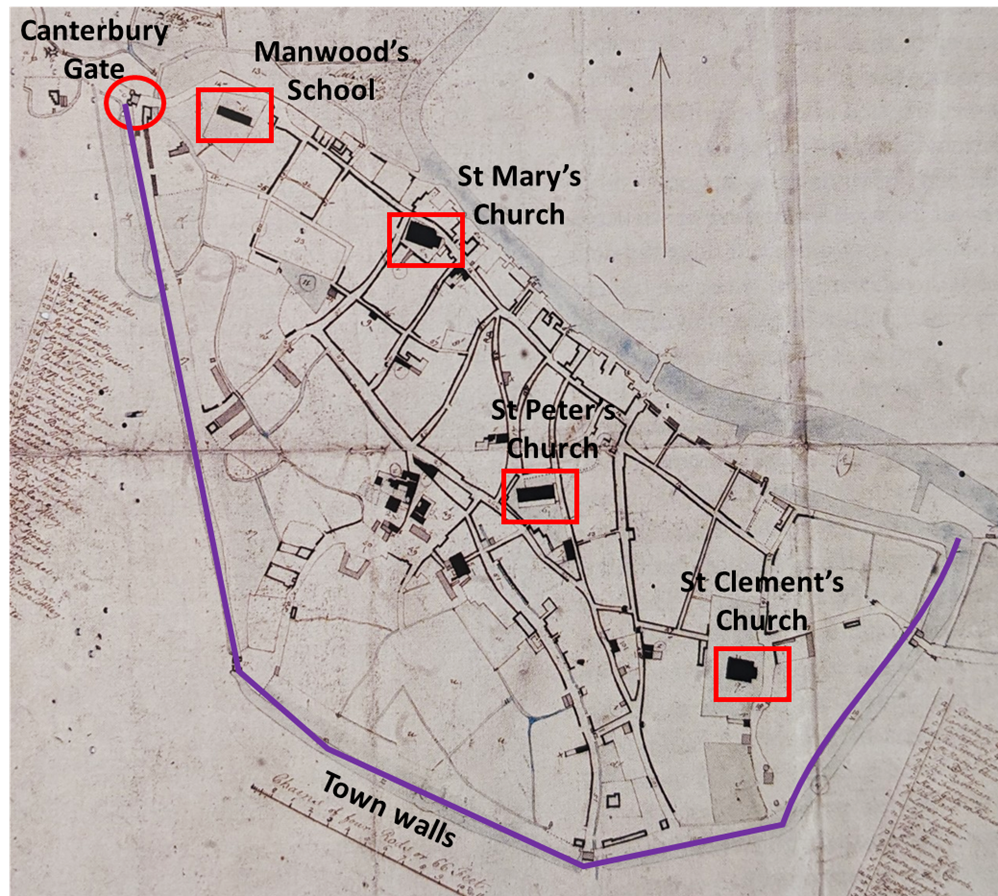
Manwood solicited the aid of his friend, Archbishop Matthew Parker in identifying a piece of land just inside the Canterbury Gate at Sandwich, ‘a piece of salts’ overlooking the Stour out towards the ruins of Richborough. Earlier in his life, Matthew Parker had been chaplain to Anne Boleyn (Elizabeth's mother) who had entrusted Elizabeth to his care shortly before her arrest and execution. His career had risen and fallen with the changing monarchs of the time (Catholic Queen Mary had demoted him), but when Elizabeth came to the throne, she chose to install Parker as Archbishop of Canterbury in her first year as monarch. The land that Parker chose for the school belonged to the Dean and Chapter of Canterbury, there having been a monastery on the site in the twelfth century, and the Archbishop used his influence with them to make a grant of the desired land. However, experience was to show that the site would have problems as it was damp and the smell from the marshes was unpleasant; a source of complaint from the masters.
With the land secured, Manwood also sought Archbishop Parker’s goodwill in securing the Royal Licence necessary for the foundation of the school. On 27 August 1563 Parker wrote to secretary of state Sir William Cecil to urge him to convince the queen to issue the letters patent to found the school, in a letter that survives in the British Library’s Lansdowne manuscripts. Parker told of how he decided to go to see the proposed site, early one ‘verie fowle, and raynye’ Sunday morning. Despite reaching Sandwich before seven, he writes that he found the mayor and jurats waiting to accompany him to church, where he admired their serious demeanour and their singing.
Archbishop Parker
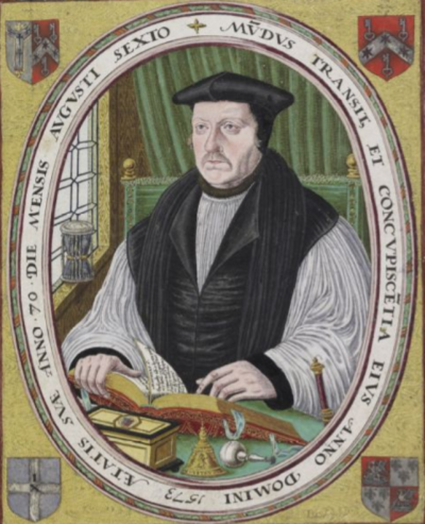
Parker’s intervention worked and the Queen readily gave permission. On 1 October letters patent were issued that empowered Roger Manwood to erect what he decided to call, with an admirable lack of humility, ‘the free grammar school of Roger Manwood in Sandwiche’ (‘libere scole gramaticalis Rogeri Manwoode in Sandwiche’). The governors were to be the mayor and juarts of Sandwich. Manwood was given licence to convey the specified lands in Hackington to the governors to provide the income for the Master, and the Dean and Chapter were given leave to make their grants of land, which they did on 2 November 1563. The way was now clear for building the school. One is impressed with the speed with which it was all accomplished.
Building of the school
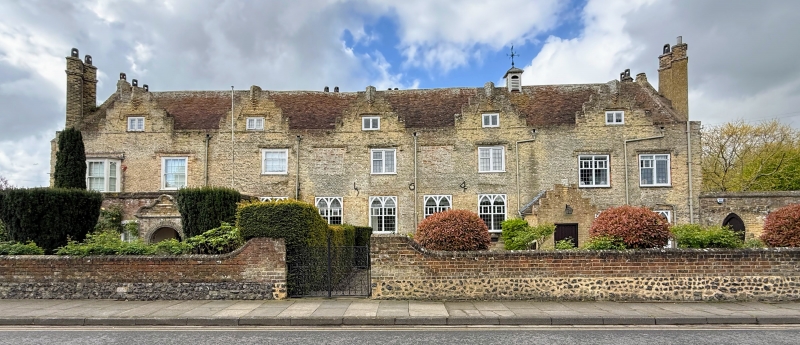
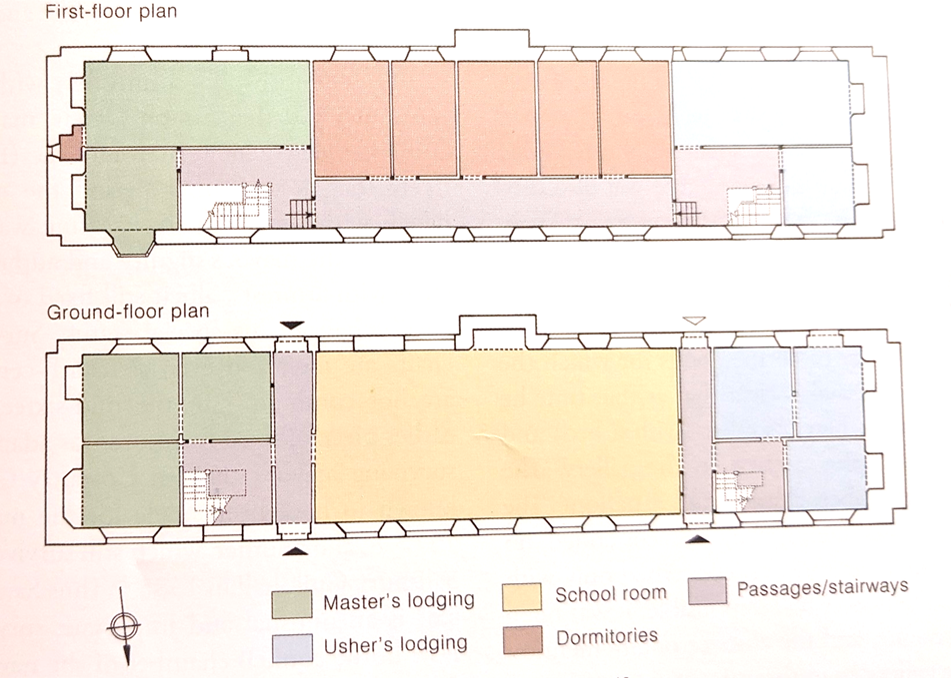
Who designed the schoolhouse, we do not know. The thre storey building (two main storeys and attics) was constructed of buff or pale yellow bricks, very similar to those used for the top of Fisher Gate in 1581, and perhaps obtained from the town’s own brickworks. The style, with crow-stepped gables above the attic windows, has been considered Flemish or Dutch, but it may simply be a case of being fashionable and up-to-date since crow-stepped gables occur throughout Kent at this time. Large chimney stacks dominate the gable ends and there is another in the middle, at the back. The long, narrow plan conforms to school designs of the period, with a tall heated school room in the centre, separated by cross passages from domestic blocks at either end.
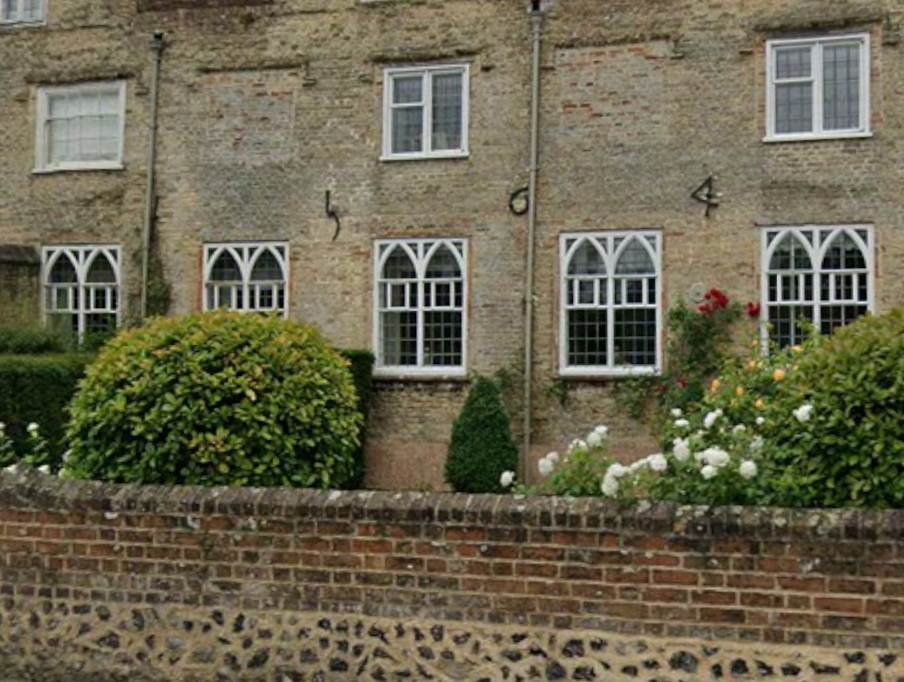
Pevsner’s guide to North East and East Kent (written by John Newman and first published in 1969) includes a short section on the school building. ‘Then at once Manwood Court, Sandwich brickwork at its most memorable. Sir Roger Manwood was granted letters patent to found a free grammar school in 1563, and this is the school-house he built, perhaps not before 1580, when the statues were drawn up (Newman was a few years out when he suggested 1580 as Queen Elizabeth had already visited the school building in 1573). Long, narrow, two-storeyed building of pallid brick. Six (in reality it's five) stepped gables towards the road. Two big chimneybreasts at each end. The windows had hood-moulds (which is a projecting decorative mould that would have sat above the windows) and one can trace them on the nine upper windows (first floor windows - two are bricked up), the end pairs set slightly lower than the rest, the symmetrical arrangement not quite meshing with the gables’.
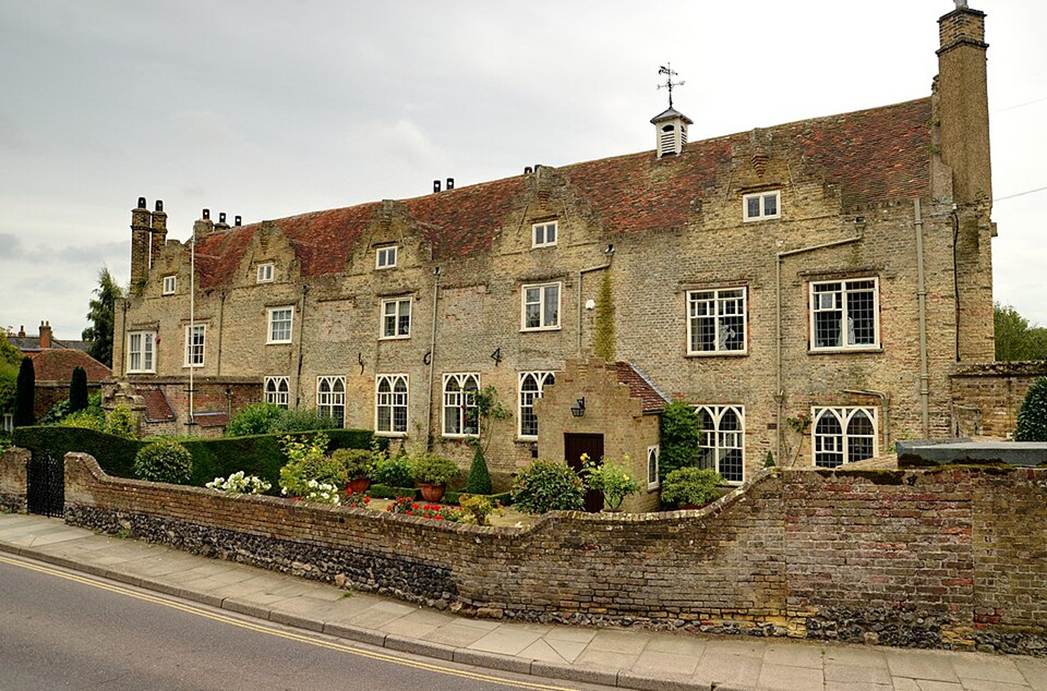
The general layout follows the common plan of the schools of the day; a large school room hall, and upstairs accommodation for the master, an usher and eighteen boarding scholars.
Building could hardly have begun before the end of 1563, but it seems that it must have been completed in 1564, as that is the date affixed on the south front of the schoolhouse. But it must be remembered that this is 1564 Old Style. The year would include the first three months of 1565 New Style; and a building of this size would surely take a full twelve months to complete. It is a fair assumption that the teaching life of the school would not begin much before Easter 1565.
Funding the school and its academic scholarships
It was in 1566 that Manwood took the step of enfeoffing (providing a gift of land) both pieces of land at Hackington in order to generate the income needed by the governors ‘for the perpetual support and maintenance of the school’. It was not an absolute enfeoffment, however for Manwood collected the rents from these lands, paying a fixed sum each year to the mayor and jurats as the school’s endowment. This he continued to do until his death and by his will charged his heirs to the estate at Hackington to do the same. For the School, this arrangement was not very satisfactory. First the payment of a fixed sum prevented it from reaping the benefit of any increase in land values; and second, it was made dependent upon the goodwill of later owners of the property at Hackington, who could not be expected to have the same personal interest as the founder himself.
Manwood’s endowment provided £20 a year as stipend for the master. This was a generous sum, and was better than that offered at some other schools, far better than that offered at Wye, Maidstone and Tenterden for example. It was, together with other gifts which quickly accrued, as Manwood said with justifiable pride, ‘good endowment for a contrie grammar schoole’.
The school's history highlights the additional contribution made to the school by Roger Manwood’s brother, Thomas Manwood – who in turn became mayor of Sandwich and Member of Parliament. "Thomas Manwood was mayor during the period of the actual building of the school. He died in 1570 and by his will, ordered his executors to gift enough of his land to the governors of the school to generate income of ten pounds annually ‘for the better maintenance and sustention of the school.’ This was again a generous sum – more than the master himself was getting at Maidstone grammar school! From his brother Thomas’s estate, Roger conveyed to the governors "two messuages (i.e. dwelling houses and surrounding land) in St Mary’s parish, a tenement and ground called the Pound Garden near the water lock in Sandwich and property in the Butchery, the total rents from which would bring in an annual income of £10." The school's history goes on to say that "The properties like the Butchery and the garden behind the schoolhouse itself, as well as premises elsewhere, remained in the possession of the School despite the total dissolution of the school in the nineteenth century. When they were finally sold, this was done so that the capital could be re-invested to bring in a bigger revenue. The sad fact is that whereas the lands of many schools founded in the sixteenth century increased dramatically in value as time passed, those provided in support of the Manwood Foundation never realised much more than their face value." Given how property prices have soared more recently, it is perhaps a shame that the school decided to cash in and sell these properties when it did!
A few years later, in 1568, we find that Roger Manwood was instrumental in establishing scholarships at Oxford and Cambridge for the benefit of boys from ‘his scole’. The school history records that these awards were made possible by the terms of the will of Joan Trappes, the widow of a London goldsmith, who left money to endow four scholarships at Lincoln College, Oxford and four more at Gonville and Caius College, Cambridge. The reasons why these scholarships were reserved specifically for students of Manwood’s School are lost in time, but it seems likely that Manwood had become an adviser to Joan Trappes, who died just as his school was being founded. Manwood also had professional dealings with Gonville and Caius that must have enabled him to establish the scholarships. At Lincoln College there seemed to be a deeper relationship as Manwood agreed that, if a vacancy for the Master of his school came up, Lincoln College would nominate two candidates and the governors of Roger Manwood's School were to choose between them. The money to pay for these scholarships came from 52 acres of land that Joan Trappes had owned in Whistable as well as land in Elham and Hardres (outside Canterbury). The documentation for this is referred to on the Lincoln College archive which can be seen by clicking here.
The school had been set up on a sure financial footing and with high hopes.
Postscript
As we probably all know, by the mid nineteenth century, the school was in an extended period of decline. It was re-established on a much bigger site on the east side of Sandwich in 1895. Today the old school building on Strand Street is two residential properties and you can read more about them in the links below. The building was listed as a Grade II* building in 1950.
Manwood Court – the right hand as you look at the building from Strand Street. Click here to see more about the house.
Manwood House – the left hand side as you look at the building from Strand Street. Click here to see more about the house
Sources and acknowledgements: this article was written by David Anderson (School Development Officer) in 2026,heavily based on a number of secondary sources:
A history of Sir Roger Manwood, written by Marten Rogers and published in 1992
History Sir Roger Manwood;s School by John Cavell Brian Kennett and published in 1963
Sandwich: The completest medieval town in England' by Clarke, Pearson, Mate & Parfitt published in 2010